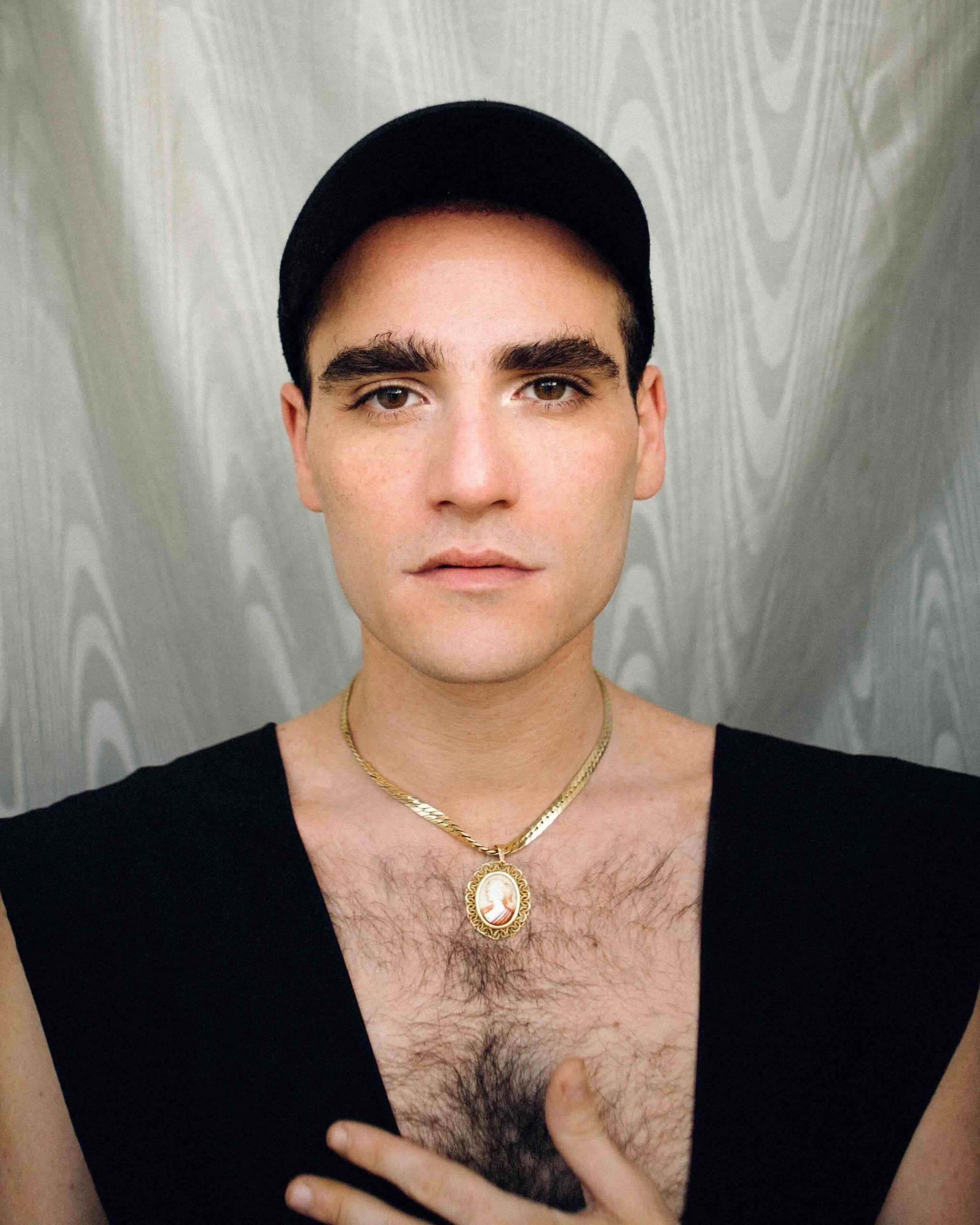
Mattia Piazza born in Palermo, Italy, Mattia Piazza pursued musical studies in opera and classical guitar. He dedicates himself to fashion design, studying at the Academy of Fine Arts in Palermo.
After completing his studies in 2016, he embarked on an experiential path of research that brought him back to Sicily, where he founded Casa Preti in 2017. He has developed collaborations with prominent artists such as Vanessa Beecroft, Gabriele Salvatores, and Claire Fontaine.
Casa Preti was founded in Palermo in 2017 from the vision of Mattia Piazza, Founder and Creative Director. The brand develops a reinterpretation of tailoring through measured volumes and constructions conceived to endure over time.
Inspired by the compositional rigor of the painter Mattia Preti, this research translates into essential, clerical lines that have become a defining signature of the house. Founded on the principle that “good equals beautiful,” Casa Preti understands craftsmanship as responsibility: a conscious supply chain, local production, and the enhancement of fabrics.
The collections express an idea of quiet luxury, understood as time, measure, and relationship. Garments are not objects, but spaces to inhabit, soft yet rigorous constructions designed to accompany the body with naturalness and truth.
How would you describe your FW26 collection?
FW26 is an act of necessity. It does not arise from the desire to produce something new, but from the urgency to take a position. Pietà is a field of tension between pietas and relativism, between individual responsibility and collective disorientation.
It is a fragile, violent, necessary collection.
We worked directly on the final fabrics, allowing the gesture — the tear, the exposed seam, the pulled thread — to become language. There is no decorative intention. To lay things bare is an act of honesty. Every garment is a house: a refuge, a space that welcomes and asks to be inhabited.
It is not a collection that asks to be looked at. It asks to be crossed.
There is often a dialogue between strength and vulnerability in contemporary womenswear. How did you explore femininity this season, and what kind of woman were you imagining while designing?
I do not think of femininity as an aesthetic category. I am interested in the human condition.
This season I worked on a woman who does not need to prove anything. Who can remain fragile without being weak. Who accepts her human nature and renounces the epic in order to build something that lasts — like Aeneas carrying his father on his shoulders and holding his son by the hand.
Strength is not in the armor, but in responsibility. Vulnerability is not a lack, but a form of truth.
Large volumes, long skirts, structured coats coexist with chiffon and organza torn without respect for the grain. It is a constant dialogue between protection and exposure. There is no verticality, no hierarchy: everything lives on a horizontal line. Every garment has the same dignity.
Fashion is constantly negotiating between fantasy and reality. In a moment like the one we are living now, what role do you believe your clothes play in shaping how women see themselves — or how they want to be seen?
I do not believe in fantasy as escape. I believe in fantasy as awareness.
In a time that normalizes violence and indifference, choosing compassion is a necessary act. My garments do not aim to construct an aspirational image, but a space. A space in which to remain, to breathe, to be exposed.
I do not want to tell women how they should be seen. I want to offer them a structure they can fill. Casa Preti should not be emptied; it should be inhabited.
If there is a role, it is this: to allow those who wear our garments to recognize themselves in their own complexity, without having to conceal it.
What about your next project?
I never think of the “next” as a rupture. For me, the process is continuous. There is no magic that renews itself every six months.
Pietà does not interrupt a path; it continues it. It is a drop within a wider flow.
The next project will be coherent with this thought. It will not try to be bigger or louder. It will try to be necessary.